
Dear Nora,
It has taken me a long time to bring myself to write this letter, mostly because I was never able to find the right words. How could I possibly express all of the thoughts and feelings I have had over the last ten months? How do I write a letter that no parent should ever have to write? How can I possibly encapsulate the sleepless nights, the worry, fear, tears, and also joy that were a part of this experience? To be completely honest, I don’t think I would’ve found that strength had it not been for your mom’s beautiful letters. Her words perfectly captured the highs and lows of our shared experience and pushed me to try and articulate my perspective on our journey together. I’ve decided to write this letter because, as incredibly hard as it is for me to do so, I feel that it serves a purpose. Throughout this journey, I’ve often felt alone, despite your mom’s best efforts. There is absolutely no guidebook for how to be a father to a child you know you are going to lose, nor how a father can express his feelings or appropriately grieve for a lost child. I’ll admit that I felt it was incredibly difficult to truly express how I was feeling to people outside of my immediate family. Our society doesn’t adequately teach men to be comfortable having frank and honest conversations about emotional topics, but I found that such conversations were exactly what I needed to begin to deal with this incredibly painful experience. I sincerely hope that openly sharing my journey as your (Nora’s) dad will help other men realize that it is not only appropriate, but essential to openly and honestly communicate their feelings, especially in times of loss.
I decided to write this letter as a series of snapshots; points that still, for whatever reason, stick out in my mind as I think about you and what your life still means to me.
The waiting. It is what I most remember from the day we found out about your heart. The view from the bench in the waiting room of the ultrasound center in Leipzig is indelibly burned into my memory. Not having your mom’s level of expertise, I still hadn’t fully grasped the enormity of the situation. I remember seeing the doctor’s drawing of your heart and still not truly comprehending. I was trying to wrap my mind around it all while trying to simultaneously comfort your mom and stop myself from crying. I remember staring into the glass administrative offices across from the bench, begging the secretary to finish processing our bill so that we could be anywhere but on that bench. I was upset that (despite our best efforts), our pain was on display for everyone to see, as the bench was just inside the main entrance of the center, right where every expecting set of parents would enter. I felt so alone, like we were the only people in the world who could possibly grasp the depths of our pain. I felt afraid, uncertain of where we had to go from here but certain that there would be more pain and plenty of tears to come.
Next came the insanity. How was I supposed to handle moving our family across the world when all I wanted to do was hide in a corner and cry? My explanation to the myriad of people I needed to talk to became almost robotic. First, explain the situation while trying to keep it together on the phone. Then, accept the condolences or deal with the awkward silence when someone couldn’t find the right words. Let’s face it, there are no words. Nothing we learn growing up provides us with the ability to adequately communicate how terrible we feel when someone encounters a situation like ours. Finally, maintain my cool when some rule or regulation gets in the way of what we really need; a quick move back to the U.S. so we can make the toughest decision we’ve ever made.
The decision. I’ll start by saying that I wouldn’t wish this part of the experience on my worst enemy. After all of the appointments with various specialists, the late-night conversations, and yes, more tears, the decision is all we were left with. Nothing in my life had prepared me for this. How can a parent possibly make a decision that literally means life or death? On one hand, we had the optimistic approach. Let’s fight for you! Let’s do everything we can to prolong your life, even if it means putting you through multiple open-heart surgeries in your first year of life, surgeries that still ultimately couldn’t fix your heart. A few years of life (maybe decades?) is better than nothing, right? I’m sure we’d be capable of explaining it all to you when you were old enough, right? We would definitely be able to tell our child that she was ultimately living with a death sentence, right? Or was that all selfish? Would that just be forcing you to live to make ourselves feel better? On the other hand, we had the realistic approach. How could we force our beautiful baby girl to undergo multiple surgeries when she was too young to understand? How could we put her through all of this pain and discomfort for an uncertain outcome? Could we truly convince ourselves that it was all worth it, even though no one could guarantee that you’d even survive all of the procedures? Here your mom’s experience was invaluable for me. She had worked with kids with your condition and was able to explain what life was like for those children and their families, and how, despite the optimistic words in support groups, the outlook (and the quality of life) was ultimately grim. Looking back, I think I knew the right decision from the beginning, but I needed to go through the excruciating process of wrestling with the pros and cons in order to convince myself that I wasn’t the worst dad ever for letting you go.
The planning. Once we’d made our decision, I lost myself in planning (honestly overplanning) every aspect of your birth with your mom. We spent countless hours covering every eventuality, from what would happen if you were too weak to leave the hospital room and died in our arms, to what would happen if we could bring you to an Airbnb nearby to die, to being able to bring you home, if only for a short while. Your mom picked out the perfect outfit for you, we packed everything we’d need regardless of where we ended up, and we coordinated the movements of a myriad of family members who wanted to be in town to support us. I even went so far as to ask for a police escort back home so we could maximize our time with you. No, even you weren’t special enough to get your own escort, but an amazingly kind dispatcher at a local ambulance company convinced her boss to donate a private ambulance ride so we could ride home with you as fast as possible. She was just one of many people who you touched, people who grieved for you with us along the way.
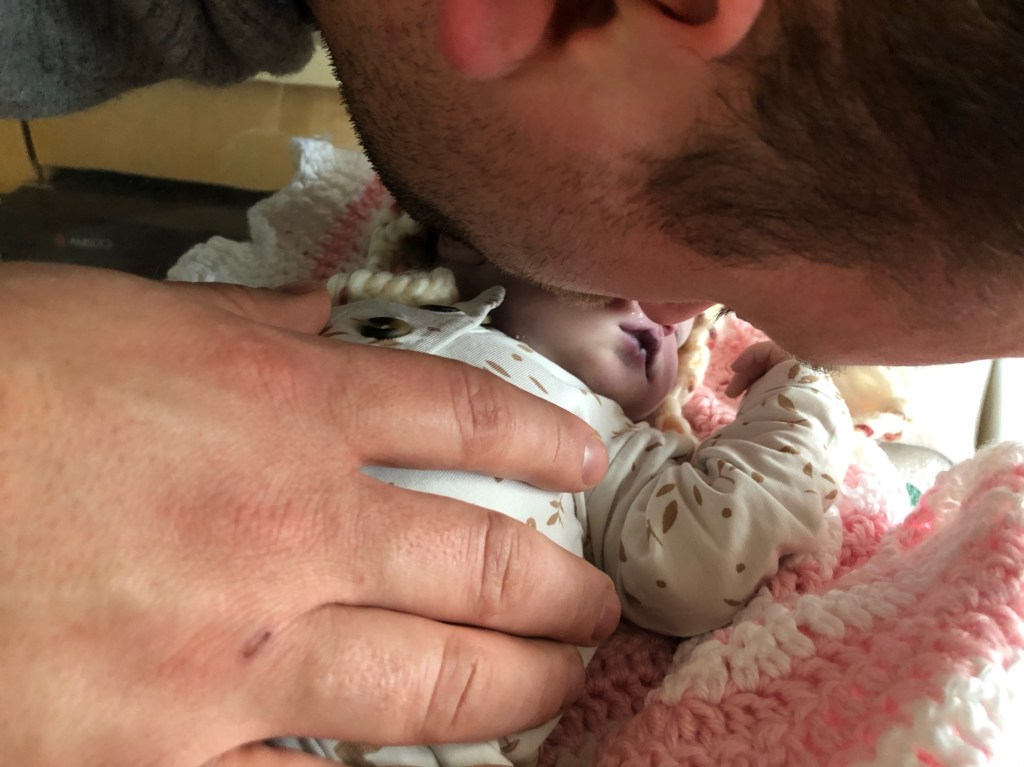
The birth. March 9th will forever be a beautiful and terrible day in my memory. We arrived at the hospital the evening prior from our Airbnb, all packed and ready to meet you. We had prepared for everything, or so we thought. The entire staff was absolutely incredible and took pains to make sure that everything would proceed exactly how your mom and I wanted it. They even wrote on the whiteboard under the Plan section: Meet Nora June! I don’t remember much about the first parts of the induction process, but I do remember how quickly the birthing process seemed to progress once your mom started pushing (your mom might disagree). Everything seemed to be moving along as expected, until suddenly it wasn’t. Your mom knew what was happening before I did, but she blessed me with another few seconds of blissful ignorance until you arrived. I remember realizing after seeing your face that I wasn’t going to get to hear the beautiful sound of your cry and wondering why. Why weren’t we going to get to meet you like we planned? What had happened? After your mom had explained everything to me the tears began to flow. I made sure that your mom was the first to hold you, and then tried my best to comfort her while I was completely falling apart. When I got the chance to hold you, I couldn’t help but notice how perfect you were. Everything about you was beautiful, which made it even more painful to realize that we weren’t going to bring you home with us. I sobbed with you in my arms, and rocked you like I did with your sisters. I made sure to sing you all of my (and their) favorite lullabies, and almost fooled myself into thinking that you were just sleeping. I watched as your mom read you a few stories, and then helped her dress you in the outfit we brought to bring you home in. We took dozens of pictures, trying our best to prolong the amount of time we had with you before we had to leave you forever.

The empty car seat. As painful as the entire experience was for me, this moment was one that sticks out in my mind as uniquely painful and poignant. I distinctly remember walking through the halls of the hospital and out to our car carrying an empty car seat. I remember wishing with all of my being that the car seat was heavier, and that I was bringing you, our beautiful Nora, home with us instead of needing to walk through the labor and delivery ward and out through the bustling hospital with a physical reminder of our loss. I felt that we were so alone in our pain and thought it cruel that the sun was shining as we walked outside. Driving home from the hospital felt surreal, like the entire experience hadn’t happened because we hadn’t brought you home with us.
The grief. I’m sure I’ll never stop grieving for you. I grieved from the moment we decided what was best for you until we lost you, and I will continue to grieve for you for the rest of my life. I grieve for what your life would have been, and the lives you would have touched. I grieve because I never got to know you, and because I wasn’t able to do a dad’s job and make everything better. I grieve because I can’t take the pain away from your mom, your sisters, your extended family, and everyone else who mourns your loss. However, in this grief, I’ve found so much beauty and love. Not only has our shared grief brought all of the people I mentioned closer together, but it has also reminded all of us of the truly important things in life. I can never thank you enough for that. Your life, however fleeting, truly meant something to all of us.
Scattering the ashes: A small plastic bag. Once we opened the container given to us by the funeral home, that was what you fit in. I remember weighing it in my hand and thinking about how it was impossible to believe that it was all that was left of you. Your mom and I had previously decided that we wouldn’t bury you or leave your ashes at a cemetery, because we didn’t know where we would eventually end up living and couldn’t bear the thought of leaving you alone. Instead, we decided to drive to the ocean and scatter your ashes. We reasoned that if we were to do it there that you would essentially end up always being there. I remember feeling tremendously sad but also happy as we all (your sisters included) took turns scattering your ashes into the sea. Even now, as I sit on a ship finishing this letter, I feel your presence, and I feel comforted knowing that you’ll never be left alone.
After: Is there really ever an after? Does the pain ever truly go away? I think about this now, almost a year after we received your diagnosis, and question if it will ever get easier. While I certainly don’t dwell on the pain as much as I used to, the tears still flow freely whenever I allow myself the time and space to think about you. Society seems to expect me (and your mom) to simply move on at some point, as if losing a child is simply something that one eventually gets over or forgets about. Sitting here now, I can tell you that I’ll never forget. While I’m sure that my grief and pain will evolve over time, you’ll always be my baby girl, and I’ll always be your dad. I’ll never forget you, and I want you to know how much I love you and how incredibly proud I am to be your dad.
Love,
Daddy
 Dear Nora
This is beautiful Chris. Thank you for sharing your heart. I love you. Mom
LikeLike